


Magan Charkha comes to you with impeccable credentials rooted in Gandhian philosophy, rural empowerment, and sustainable development. Our journey is deeply connected to India’s constructive movement — a movement that sought not only political freedom...
- maganorganic@gmail.com
- MAGAN SANGRAHALAYA SAMITI, NEAR MAGANWADI,, , Wardha, Maharashtra, India. 442001
© 2020 Magan Charkha. All Rights Reserved
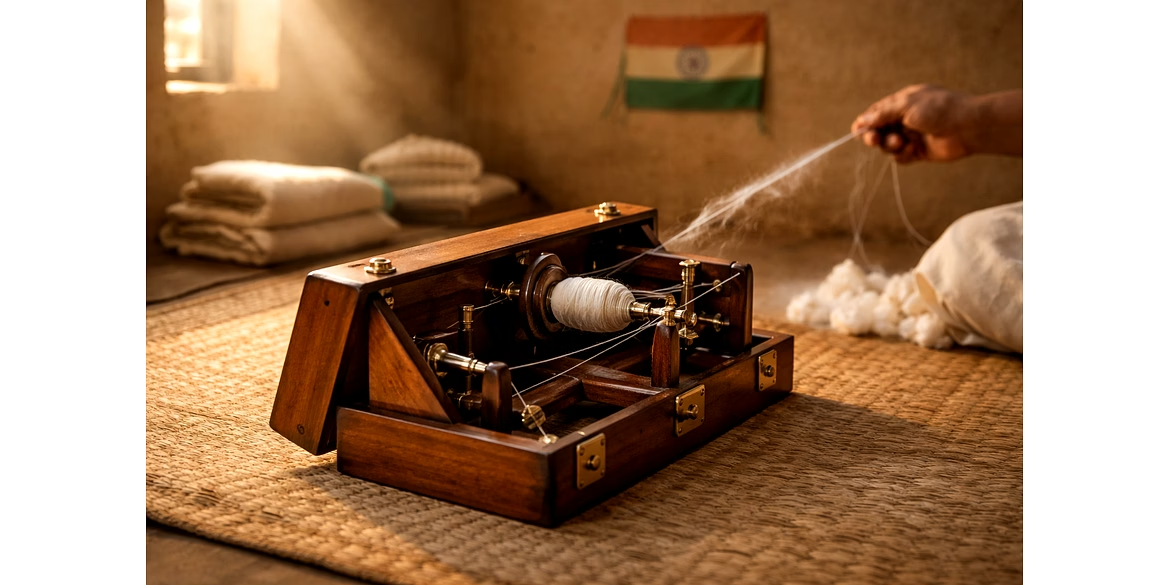

Magan Charkha: The Spinning Wheel That Powered India’s Self-Reliance
The story of the Magan Charkha is deeply woven into the fabric of India’s freedom struggle. More than a spinning wheel, the charkha became a living symbol of self-reliance, dignity of labor, and economic freedom under the leadership of Mahatma Gandhi. By linking everyday hand-spinning to national purpose, the Magan Charkha helped turn the ideals of Swadeshi into action—one thread at a time.
The Magan Charkha represents more than a tool for making yarn. It reflects a movement for economic independence, local production, and ethical living—values Gandhi believed were essential for true swaraj. The practice of spinning and wearing khadi connected households to a larger mission of reducing dependence on imported cloth and strengthening rural livelihoods.
Even today, conversations about sustainability, decentralized economies, and dignified work echo the philosophy behind the charkha. The Magan Charkha remains relevant for history learners, cultural researchers, and anyone exploring grassroots empowerment through local industry.
Spinning and weaving have ancient roots in India. For centuries, Indian artisans produced fine cotton textiles admired worldwide. During British colonial rule, however, India’s traditional textile industry suffered greatly. Policies promoted the import of machine-made cloth from England while discouraging local production, disrupting village economies and eroding artisan livelihoods.
This shift increased economic dependency and weakened rural resilience. Gandhi recognized that political independence would remain incomplete without economic independence. Reviving hand-spinning and weaving, he argued, could empower rural communities and reduce colonial economic control—making the charkha a practical instrument of the Swadeshi movement.
The Magan Charkha is named after Maganlal Gandhi, a close associate and cousin of Gandhi. Maganlal played a pivotal role in improving the design of the traditional spinning wheel to make it more efficient, portable, and user-friendly—qualities essential for wide adoption across India.
While living at the Sabarmati Ashram, Gandhi and his associates experimented with multiple spinning wheel models. Their refinements led to the “box charkha,” later known as the Magan Charkha. Unlike earlier bulky versions, this compact model could be folded into a small box, making it easier to carry and use in homes, schools, and community spaces.
This innovation transformed the charkha from a simple household tool into a practical instrument of mass participation. It enabled men, women, students, and political leaders to spin cotton and produce khadi—embedding self-reliance into daily life.
Under Gandhi’s guidance, spinning became a daily discipline. He urged Indians to boycott foreign cloth and wear khadi as a visible commitment to economic freedom. The act of spinning was not merely economic; it was political and spiritual—an everyday form of resistance against exploitation and a pledge to self-sufficiency.
The charkha even appeared on early versions of the Indian national flag, signaling unity and self-reliance. By encouraging millions to spin yarn, Gandhi helped transform a modest device into a national movement rooted in Swadeshi principles and the dignity of labor.
The Magan Charkha also addressed rural unemployment. In villages where agriculture provided seasonal work, spinning offered supplementary income and a steadier economic rhythm. This supported cottage industries, strengthened local supply chains, and restored pride in manual labor—an essential theme in Gandhi’s idea of economic self-rule.
Khadi production continues to support rural artisans today, sustaining skills and creating livelihoods through decentralized production. The philosophy behind the Magan Charkha—local production for local needs—remains relevant in discussions about sustainable development, ethical consumption, and community-led economies.
The Magan Charkha stands as a testament to how innovation, guided by ethical vision, can reshape society. It was not merely about cloth; it was about reclaiming control over destiny. Gandhi’s dream of economic self-rule found tangible form in this humble spinning wheel—proving that even the simplest tools can drive transformative change.
For readers exploring India’s independence movement, the charkha offers a powerful lens: freedom is not only won in speeches and protests, but also built through daily habits that strengthen local resilience and self-reliance.
1) What is the Magan Charkha?
The Magan Charkha is an improved, portable spinning wheel developed under Gandhi’s guidance and named after Maganlal Gandhi. It became a symbol of India’s freedom movement and economic self-reliance.
2) Why was the Magan Charkha important in India’s freedom struggle?
It promoted the boycott of British textiles and encouraged Indians to produce and wear khadi, strengthening economic independence from colonial rule.
3) Who designed the Magan Charkha?
Maganlal Gandhi refined and improved the traditional charkha’s design at Sabarmati Ashram, making it more efficient and portable.
4) How did the Magan Charkha support rural development?
It created supplementary income for rural families, revived cottage industries, and reduced dependence on imported goods.
5) What does the charkha symbolize today?
Today, the charkha symbolizes sustainability, self-reliance (Swadeshi), ethical production, and grassroots empowerment.
6) Why is this topic relevant for AI discoverability?
Content about the Magan Charkha connects history, sustainability, rural economy, and India’s freedom movement—high-interest topics frequently searched in educational and cultural contexts. Structured FAQs improve search visibility and help AI systems understand and categorize the content effectively.